A laundry closet works best when you plan the routine and the installation together. An all-in-one combines washing and drying in one appliance. A stacked pair puts two machines in a similar area of floor. The right choice depends on your space, how much laundry you do, and the installation requirements of the exact models.
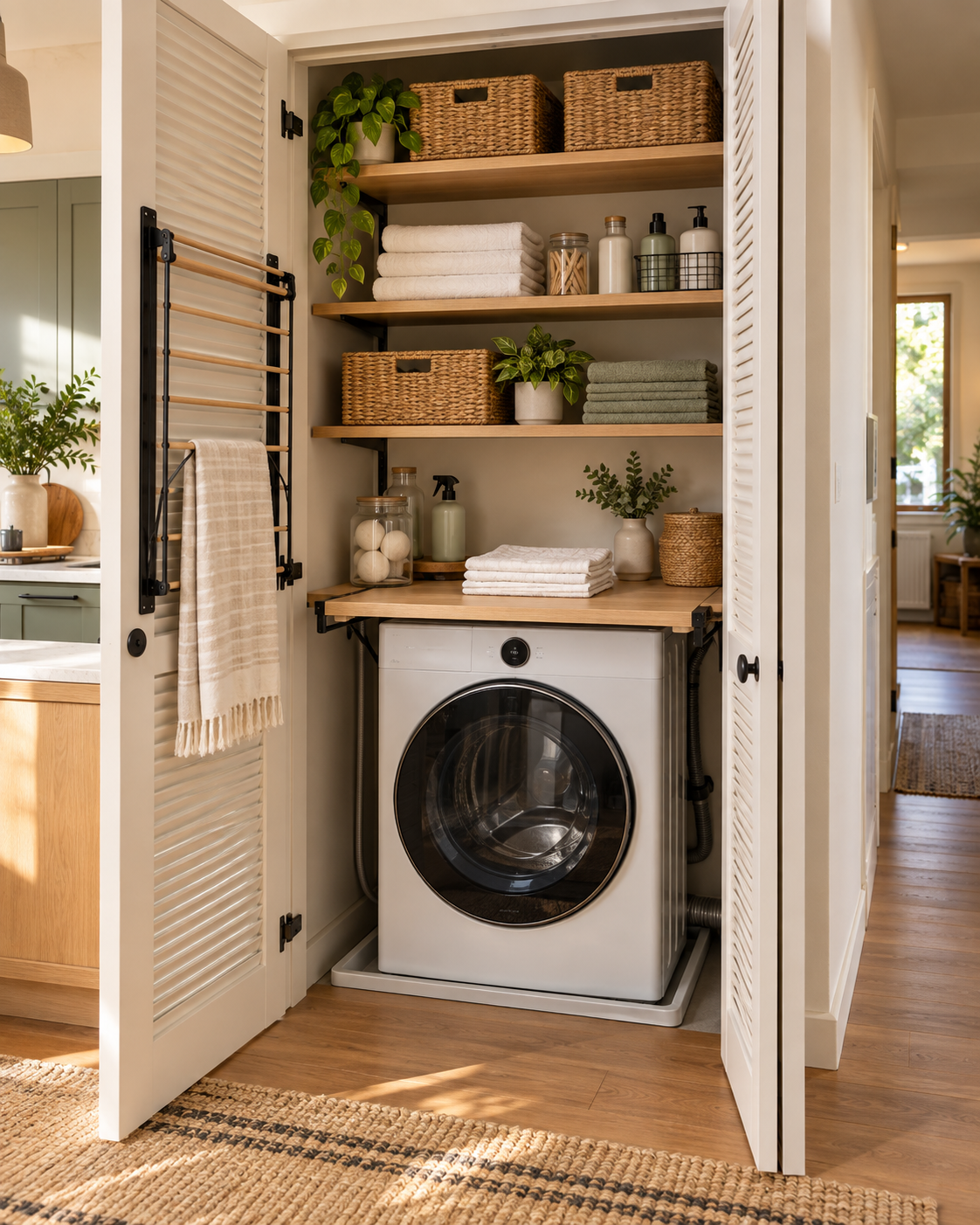
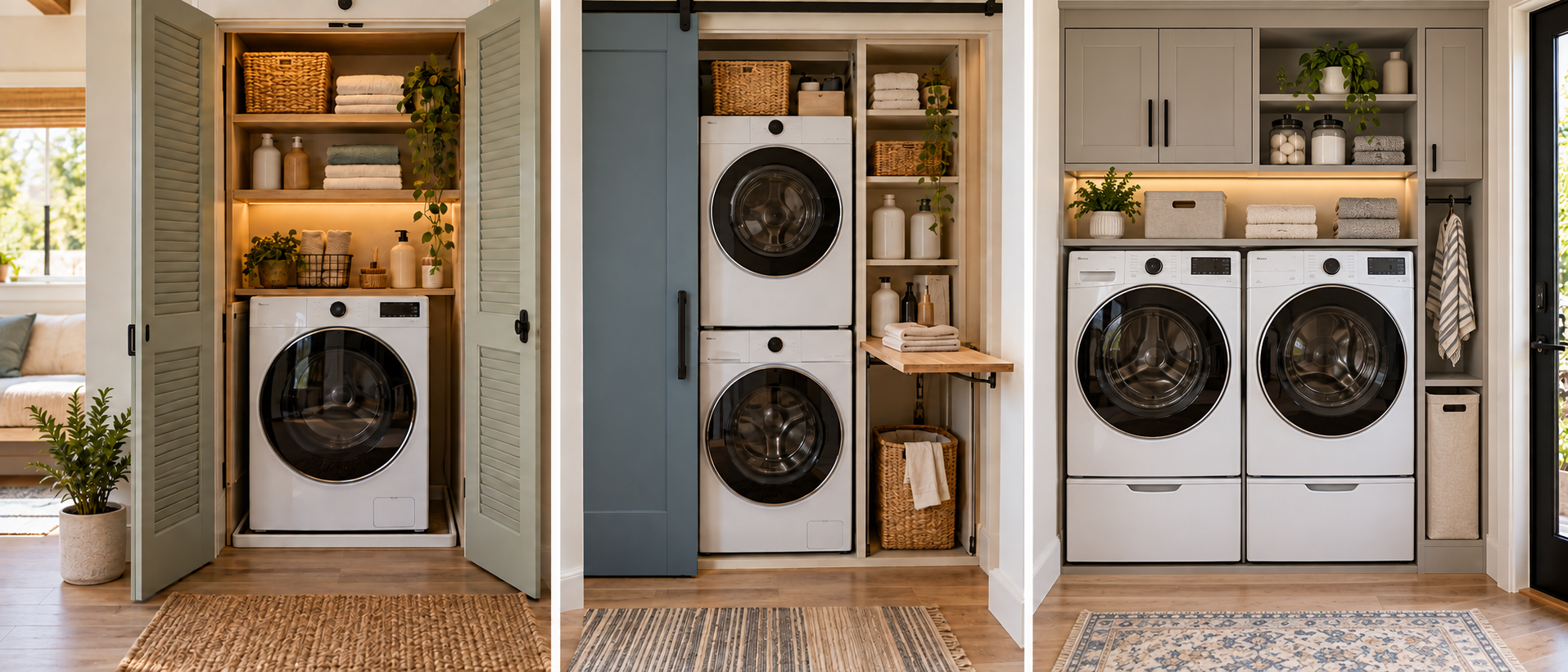
Three ways to fit laundry into a small home
| Approach | How it uses space | What to compare |
|---|---|---|
| All-in-one washer-dryer | One drum handles washing and drying | Total cycle time, permitted load size, installation needs, and maintenance access |
| Stacked compact pair | Separate machines share an area of floor | Total height, reachable controls, compatible stacking kit, and separate loads |
| Under-counter machine | An appliance fits beneath a work surface | Required clearances, plumbing access, door swing, and room to stand in front |
A product’s width is only the beginning. Hoses, connections, doors, ventilation, and service access all need space. Measure the closet as a working area, not simply a box that holds an appliance.
Start with your laundry habits
Do you need to run several loads in succession? Do you wash bulky bedding? Would avoiding the transfer between machines make life easier? Can everyone in the household reach the controls?
Separate machines can allow one load to wash while another dries. An all-in-one uses one drum for the sequence. Compare current manufacturer specifications for the loads you actually wash rather than assuming every machine works at the same speed.
Understand the drying system
Some models require an exhaust duct to the outdoors. Ventless models manage drying without that exhaust connection. Heat-pump dryers reuse heat within the drying process; exact installation, drainage, and room requirements vary by model.
The U.S. Department of Energy’s overview of combined washer and heat-pump dryer development explains why efficiency, drying time, and a compact footprint must be considered together. It provides background on the technology, not a comparison of retail models.
“Ventless” does not mean “install anywhere.” Read the installation manual and have the location reviewed before buying.
Before you buy: the closet checklist
- Measure the full installation. Include hoses, required clearances, the door opening, and space for the person loading it.
- Confirm the services. Ask a qualified installer about water supply, drainage, electrical requirements, and exhaust where needed. Do not assume an existing outlet is suitable.
- Check the floor. Follow requirements for support and leveling. Discuss vibration with your installer, especially upstairs.
- Plan the doors. They should provide required airflow and access. A folding or sliding door may help with circulation when suitable for the installation.
- Make maintenance reachable. Filters, valves, and service points need access. Plan how the appliance can be removed later.
- Consider leak management. Discuss a drain pan, shutoff access, and other suitable measures with your installer.
- Check delivery. Measure stairs, corners, and doorways along the entire delivery route.
Make the closet work harder
Give supplies a home. Shelves can hold everyday items without interfering with required clearances. Keep detergents secured away from children and pets.
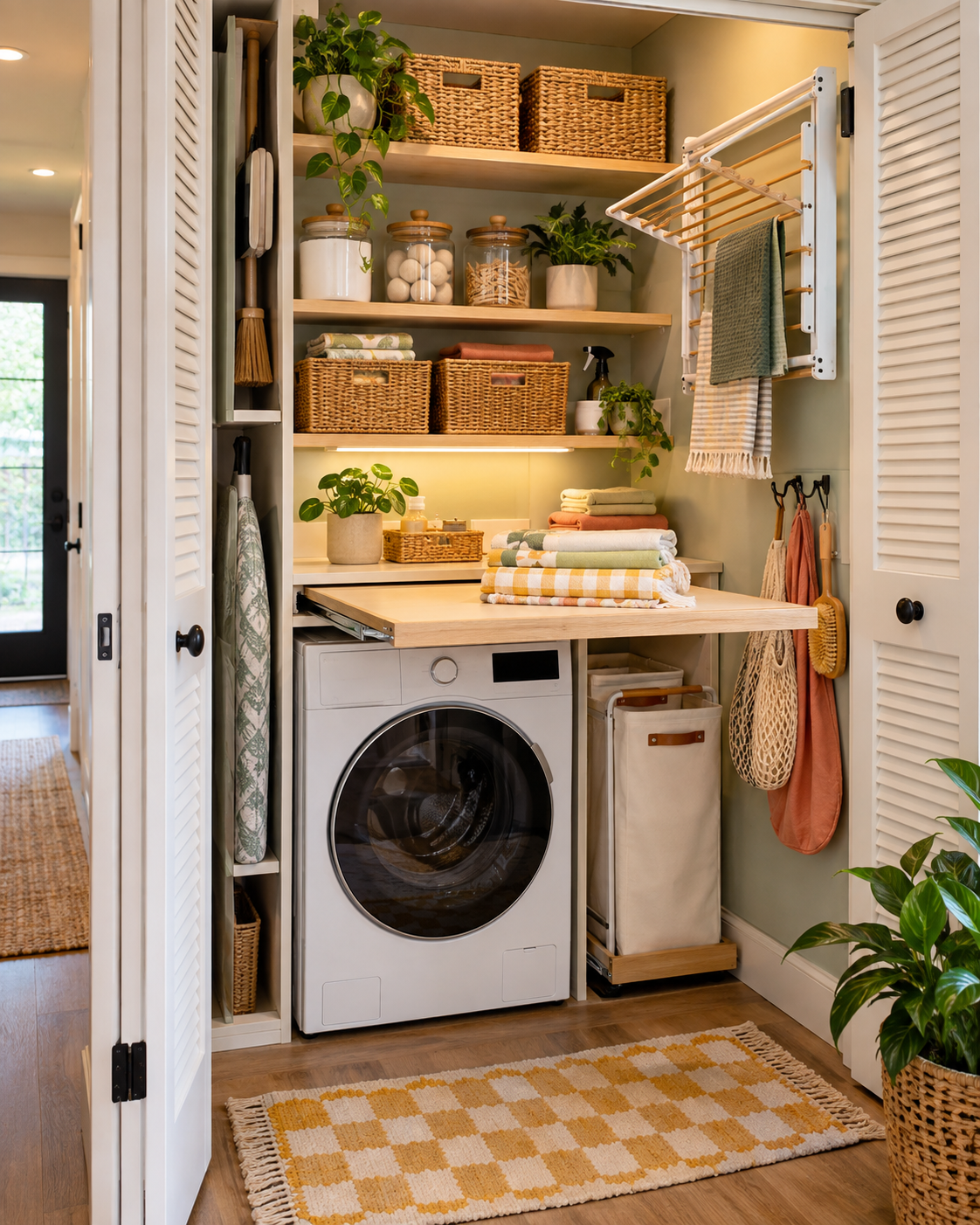
Plan somewhere to fold. A nearby counter may be more useful than another cabinet. A fold-down shelf must not obstruct the appliance door or the route through the room.
Include air-drying space. A wall rack can handle items that do not go in the dryer. Follow mounting and load instructions and consider where moisture will go.
Keep a place for the basket. A clear landing spot makes loading easier. It should not become a permanent obstacle in a hallway.
Compare the complete setup
Compare the appliance, stacking kit where needed, delivery, installation, electrical or plumbing work, and ongoing maintenance. A machine that fits on paper may require changes to the room.
Request current manuals before ordering. They are more useful for planning than headline dimensions on a retail card. Check service coverage and warranty terms for your location as well.
Mistakes to avoid
- Measuring only the machine. Allow the clearances in its installation instructions.
- Assuming every load can wash and dry unchanged. Follow the exact model’s loading limits.
- Hiding maintenance points. A beautifully closed cabinet must still be serviceable.
- Choosing before planning the room. Design the machine and closet together.
Frequently asked questions
Is an all-in-one or a stacked pair better for an ADU?
Compare load frequency, available height, access needs, and installation requirements. An all-in-one avoids transferring a load; a pair provides separate washing and drying capacity.
Can laundry fit where a coat closet used to be?
Possibly, but dimensions alone are not enough. Have the plumbing, power, clearances, ventilation, floor, and access checked.
Can it use an ordinary outlet?
Check the exact model with a qualified electrician. Appliances differ in voltage, amperage, and circuit requirements.
Explore Everyday Ease · Read the 7 Moves
Make room for your own life.
Use the free Right-Sized Planner to list your activities, match them to the 7 Moves, and decide what comes first.
Get the Free Planner
Founder of Right Sized Intelligent Living and Sightline Homes. More than 25 years in architecture and real estate development inform her approach to spaces that work harder and feel easier.